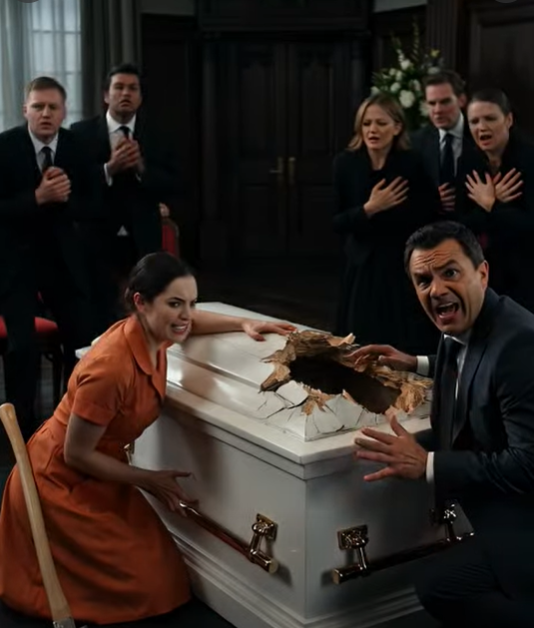
The Maid Smashed Open a Coffin During a Millionaire’s Funeral and Screamed That His Wife Was Alive. When She Woke Up, She Pointed at the Priest.
The Coffin That Moved
Nobody was looking at the maid when it happened.
All eyes were on the white coffin at the center of the funeral parlor, on the flowers arranged too neatly around it, on the older man in black standing beside it with the stiff posture of someone trying to survive grief by controlling every inch of it.
The room smelled of lilies, polished wood, and silence.
Vivian Vale had been beautiful even in death.
That was what people whispered.
Not kind.
Not generous.
Not loved.
Beautiful.
Her face had been printed across charity brochures for three decades. Her name appeared on hospital wings, scholarship funds, orphan programs, museum plaques, and every society page that still pretended old money had a soul. She had been the soft public face beside her husband’s severe one.
Edgar Vale stood beside the coffin like a monument carved from grief.
He was seventy-one, tall, narrow, and impossibly controlled. His black suit looked custom-made for mourning. His silver hair was combed perfectly back. His hands rested on the coffin lid with the stillness of a man who had already decided how the world would remember this day.
I was standing near the side wall, half-hidden behind a column of white roses, watching him.
My name is Nora Whitlock. I write obituaries for The Boston Ledger.
That sounds gentle.
It is not.
Obituaries are where powerful families try to control the last version of a life. They send clean sentences, polished achievements, careful timelines. My job was supposed to be making death readable. Over the years, I learned something darker.
The dead are rarely the ones hiding the most.
Vivian’s obituary had been strange from the beginning.
Too fast.
Too complete.
Too expensive.
Her death had been announced at 7:12 that morning. By 10:00, my editor had received a full memorial package from the Vale estate: portraits, approved quotes, foundation history, burial details, and a request to run the tribute before evening.
No autopsy.
No delay.
No public illness before that week.
Just sudden heart failure.
Final.
Convenient.
I had come to the funeral parlor because Vivian had sent me a letter three days before she died.
It arrived at my office in a plain cream envelope.
Inside was one sentence written in blue ink.
If I die before Sunday, do not believe the priest.
No signature.
But I knew the handwriting.
Two years earlier, Vivian had mailed handwritten thank-you notes after I interviewed her about the Vale Children’s Shelter. Her V’s curved sharply at the base. Her t’s were crossed with a strange upward flick.
Same hand.
Same fear.
I had spent the morning trying to understand what it meant.
Then the axe came down.