PART ONE — THE MAN WITH THE SCARRED HANDS
“Ten thousand dollars, sir.”
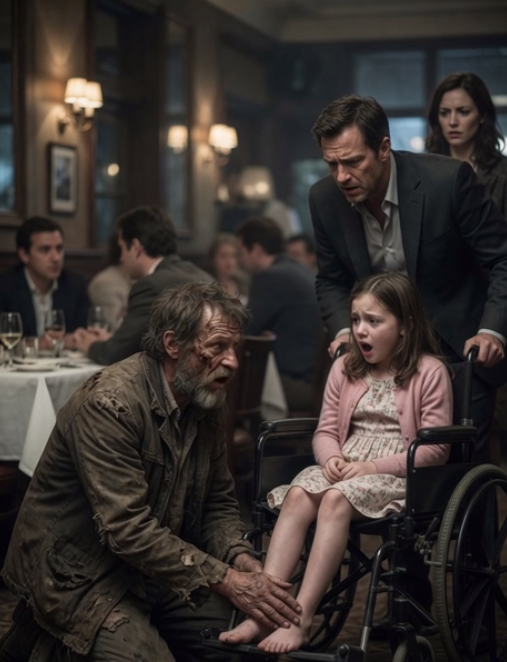
The ragged man stood beside our table as though he belonged in the most exclusive restaurant in Manhattan.
He did not.
His coat was torn at both elbows. Mud covered his boots. A pale scar crossed the left side of his face and disappeared beneath a rough beard. His hands were dark with grease, dirt, and old burns.
Every diner near us had stopped eating.
I tightened my grip on my daughter’s wheelchair.
“What did you say?”
The stranger looked past me toward nine-year-old Sophie.
“Ten thousand dollars,” he repeated calmly. “And I will return what was taken from her.”
Sophie sat beside the table in a white silk dress, her small hands folded carefully in her lap.
Two years earlier, she had entered St. Matthew’s Children’s Hospital for what Dr. Miles Corbin described as a routine spinal procedure. She had been experiencing numbness in two toes after a fall from a horse. The surgery was supposed to relieve pressure around a nerve.
She awakened unable to feel anything below her waist.
I took her to specialists in Boston, Zurich, London, and Singapore. I spent more than four million dollars on rehabilitation, experimental treatments, custom equipment, and doctors who promised hope before quietly admitting there was none.
Every report reached the same conclusion.
The damage was permanent.
Now a homeless man stood beside my daughter asking for ten thousand dollars as though he could undo what the greatest surgeons in the world could not.
I looked toward the restaurant manager.
“Call security.”
The stranger did not move.
“Mr. Vale, your daughter was not born unable to walk.”
“That information is public.”
“She was not injured by the surgery either.”
My hand froze against the wheelchair.
Sophie looked up at him.
“What do you mean?”
His expression softened.
“Someone took the feeling from your legs.”
A nervous murmur spread through the dining room.
I stood.
“That is enough.”
Two security guards began crossing the restaurant.
The man slowly lowered himself beside Sophie’s wheelchair.
I stepped between them.
“Do not touch my daughter.”
“You trusted men wearing white coats for two years,” he said. “Yet you fear me because my coat is dirty.”
“You approached a child asking for money.”
“The money is not for me.”
“Then who is it for?”
His eyes moved toward the woman seated across from me.
Camille Hart sat perfectly still.
Camille was my late wife Rebecca’s younger sister. She had moved into our home after Rebecca died in a car accident. She managed Sophie’s medication, attended appointments, and stayed beside her during the nights when phantom pain kept her awake.
Camille placed one hand against her chest.
“Why are you looking at me?”
The stranger did not answer.
The security guards reached us.
“Sir, you need to leave.”
The man suddenly placed both hands around Sophie’s bare feet.
I lunged forward.
Sophie screamed.
“Dad!”
Her face went white.
The guards seized the man’s shoulders, but he held on for one more second.
Sophie gasped.
“It’s hot.”
“What is?”
“My feet.”
Her breathing became fast.
“Dad, the floor is cold.”
I stared at her.
She had not felt temperature in two years.
“I can feel his hands.”
The stranger released her.
The guards pulled him backward.
Sophie gripped the sides of her wheelchair. Before anyone could stop her, she placed both feet flat against the marble floor.
Her knees shook.
I reached for her.
She pushed herself upright.
For one impossible second, my daughter stood.
The restaurant erupted.
Someone screamed.
Several people raised their phones.
Camille knocked over her wineglass. Red wine spread across the white tablecloth like blood.
Sophie took one unsteady step.
Then another.
She collapsed into my arms, crying.
“Dad, I felt it. I felt everything.”
I held her so tightly she could barely breathe.
The stranger remained on his knees between the guards.
“Do not make her walk again tonight,” he said. “Her nerves are awake, but they are weak.”
“What did you do?”
“I interrupted the signal.”
“What signal?”
He looked at Camille.
“The one created by the device hidden beneath her surgical scar.”
Camille stood so quickly that her chair fell.
“There is no device.”
The man smiled without warmth.
“Then why did you increase her medication this morning?”
My sister-in-law’s face changed.
Only for a moment.
But I saw it.
“Camille?”
She shook her head.
“He’s manipulating you.”
“How does he know about her medication?”
“He could have followed us.”
The stranger removed a folded medical image from his coat and dropped it onto the floor.
It was an X-ray of Sophie’s lower spine.
A tiny object had been circled in red near the base of one vertebra.
The image carried the letterhead of St. Matthew’s Children’s Hospital.
The date was three weeks after Sophie’s surgery.
I had never seen it.
“What is this?”
“A neuroblocking implant,” the man said. “No larger than a grain of rice. It releases electrical pulses that interrupt communication between her spinal cord and her legs.”
I looked toward Dr. Miles Corbin.
He was seated with his wife three tables away.
He had approached us earlier to ask about Sophie’s latest therapy.
Now he was standing near the exit.
“Dr. Corbin.”
He stopped.
I held up the scan.
“Is this possible?”
“I cannot evaluate an image in a dining room.”
“Come closer.”
“I think Sophie needs immediate medical attention.”
“Then examine it.”
He did not move.
The stranger laughed quietly.
“He won’t.”
Dr. Corbin’s face hardened.
“Who are you?”
The ragged man lifted his chin.
“You truly don’t recognize me?”
For the first time, Corbin looked closely at the scarred face.
His expression collapsed.
“No.”
Camille began backing toward the kitchen.
I caught her wrist.
“Where are you going?”
“Sophie needs her emergency medication.”
The stranger’s voice became sharp.
“Do not give it to her.”
“She could go into shock.”
“No. The injection will suppress the signal again.”
Sophie clung to my jacket.
“Aunt Camille gave me a shot before dinner.”
I looked down.
“What shot?”
“The one she gives me when my legs hurt.”
Camille shook her head.
“It is part of her treatment.”
“She told me not to tell you because you would worry,” Sophie whispered.
Something cold opened inside my chest.
“What have you been injecting into my daughter?”
Camille’s eyes filled with tears.
“I was helping her.”
The stranger looked toward the restaurant manager.
“Lock the doors.”
The manager hesitated.
“Do it,” I ordered.
The entrances were secured.
Corbin moved toward a service hallway.
A guard blocked him.
The stranger rose.
“My name is Elias Kane.”
Corbin stared at him.
“That man is dead.”
Elias touched the scar across his face.
“You certainly tried.”
The room became silent.
“Who is he?” I asked.
Elias answered.
“I designed the spinal interface used during Sophie’s surgery.”
Corbin spoke quickly.
“He was a laboratory technician who became unstable.”
“I was the lead biomedical engineer.”
“You falsified research.”
“I discovered you were implanting unapproved devices in children.”
Corbin’s wife moved away from him.
Elias continued.
“The device in Sophie’s back was not designed to heal paralysis. It was designed to create it temporarily.”
Sophie’s fingers tightened around mine.
“Why would anyone do that?”
“To control you.”
“That makes no sense.”
“You are Adrian Vale. Your medical foundation funds nearly a third of the pediatric neurological research in this city.”
“What does that have to do with Sophie?”
“After Rebecca died, you planned to withdraw the foundation’s support from St. Matthew’s.”
I remembered the argument.
Rebecca had discovered irregularities in several research grants before her accident. After her funeral, I considered ending every hospital contract she had questioned.
Then Sophie lost the use of her legs.
Corbin told me St. Matthew’s had the only program capable of preserving her remaining nerve function.
I renewed the funding.
Then doubled it.
“They used my daughter to keep the money coming.”
“More than sixty million dollars over two years,” Elias said.
I turned toward Camille.
She had encouraged every donation.
Every research grant.
Every private payment.
“You knew?”
“No.”
“Why were you giving Sophie injections without telling me?”
Her mouth opened.
Nothing came out.
Elias pulled a recorder from his pocket.
“The ten thousand dollars was never a price for healing Sophie.”
He pressed play.
Camille’s recorded voice filled the restaurant.
“Ten thousand now. The rest after Adrian signs the permanent research endowment.”
Corbin answered.
“And the child?”
“Keep her condition stable. Adrian must continue believing she could improve if he funds the program.”
Camille’s knees weakened.
“That recording is fake.”
Elias played a second conversation.
This time Camille was crying.
“You promised she would never feel pain.”
Corbin replied, “She is not supposed to feel anything. Increase the dosage.”
I released Camille’s wrist as if her skin had burned me.
Sophie stared at her aunt.
“You made my legs stop working?”
Camille covered her face.
“I never meant for it to last this long.”
The confession tore through the room.
“Why?” I asked.
She looked at me through tears.
“Because Rebecca was going to leave you everything.”
“My wife was already dead when Sophie had surgery.”
“She changed her will before the accident.”
“What does that have to do with you?”
“You were supposed to marry me after she died.”
Every person nearby fell silent.
Camille was not my sister.
She was Rebecca’s younger sister.
After Rebecca died, Camille moved into our home to help care for Sophie.
I believed she was honoring Rebecca.
She had been waiting to replace her.
“You thought I would marry you?”
“You needed someone.”
“I needed help raising my daughter.”
“You trusted me with everything.”
“Because you were Rebecca’s sister.”
Her face twisted.
“I spent my entire life being Rebecca’s sister.”
Sophie began crying.
“You hurt me because of Mom?”
Camille reached toward her.
“No, sweetheart.”
I stepped between them.
“Do not touch her.”
Corbin suddenly shoved the guard and ran toward the service corridor.
Elias chased him.
I followed.
Near the private elevator, Elias grabbed Corbin’s coat. They crashed against the wall.
A syringe fell from the doctor’s pocket.
The label carried Sophie’s name.
Elias examined it.
“That dose would have stopped her heart.”
Police sirens sounded below us.
Officers entered from the kitchen and arrested Corbin.
Camille did not resist.
As she was handcuffed, she looked at me.
“You think Elias saved her?”
“He made her stand.”
“For thirty seconds.”
Her tears stopped.
A strange smile appeared.
“That implant cannot be disabled by touching her feet.”
Elias pulled a scanner from beneath his coat and passed it along Sophie’s spine.
A red light flashed.
Then another signal appeared.
EXTERNAL CONNECTION ACTIVE
“Someone is controlling it remotely,” Elias said.
“From where?”
He turned toward the private dining balcony.
An elderly woman stood behind the glass.
She wore a silver dress and held a black remote.
Sophie stopped breathing.
“Grandma?”
My mother had been declared dead seven years earlier.
Yet Evelyn Vale stood above us, watching her granddaughter.
She pressed a button.
Sophie screamed and collapsed against me.
Elias grabbed the scanner.
“We have less than ten minutes before the implant burns through the nerve tissue.”
I stared at the woman I had buried.
She smiled through the glass.
Then she mouthed four words.
Bring me Rebecca’s will.