The False Miracle: How My Wife Stole A Decade Of My Life
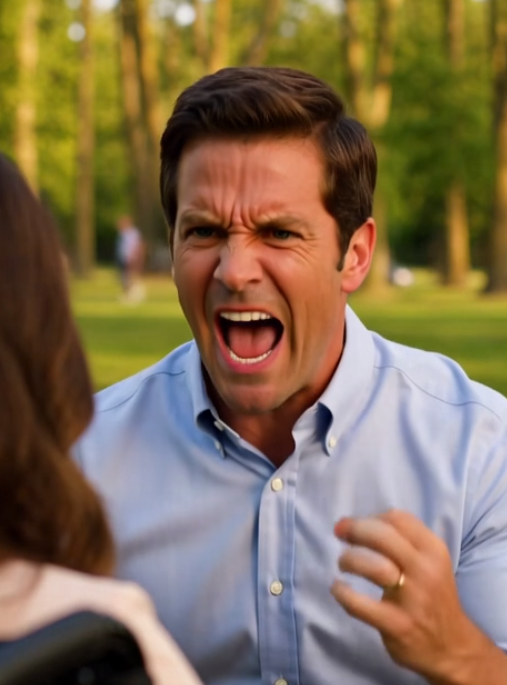
The silence in the park became absolute. Victoria didn’t try to run, which was perhaps the most chilling part of her performance. She merely sat in that high-end, motorized chair, her hands folded neatly in her lap, looking up at me with eyes that lacked even a trace of remorse.
The boy, no older than ten, gripped his phone tighter, his small knuckles white. He looked between us, waiting for the explosion he knew was coming. I couldn’t breathe. My lungs felt filled with wet sand, and my hands, which had spent ten years gently lifting her into bed, helping her bathe, and securing her leg braces, felt like they belonged to a stranger.
You didn’t know? Victoria asked. Her voice was steady, lacking the slight, breathy tremor she used when she wanted to play the fragile invalid. It was cold, sharp, and entirely too familiar for someone who claimed to have spent her life in agony.
I stared at the wheels of her chair, realizing for the first time that the dust on the tires was consistent with outdoor use, but the tread on her shoes—the expensive, orthopedically designed shoes I had bought her—was completely pristine. I had been so busy protecting her that I had stopped looking at the reality right in front of my face.
I walked toward the boy and took the phone. I hit play again. The footage was grainy but undeniable. Victoria, walking through a crowded gallery with a glass of champagne, laughing with a man I didn’t recognize. She moved with a grace and fluidity that made my chest tighten with a sickness I couldn’t name.
The boy finally spoke, his voice cracking. She used to pay me to watch the neighborhood and tell her if you were coming back early. She was my neighbor, but she was never the woman you thought she was.
I dropped the phone. It hit the grass with a muffled thud. The boy scrambled to retrieve it and ran, leaving me alone with the woman who had effectively held me hostage in my own home.
Why? I finally managed to croak. My voice sounded foreign, brittle.
She unbuckled the strap across her waist, the one that kept her from sliding out of the chair if she were truly paralyzed. She leaned forward, the movement liquid and effortless. Because you were the perfect mark, Richard. You had that relentless, stupid need to save someone. It was so easy to play the victim until you signed over your savings, your inheritance, and your career to cover my medical bills.
I looked at my hands again. The medical bills. I had liquidated my retirement fund three years ago to pay for a breakthrough surgery that was supposed to help her regain sensation in her legs. The money hadn’t gone to a clinic. It had gone to her.
You aren’t just a fraud, I said, my voice rising. You’re a thief.
She laughed, a low, melodic sound that chilled me to the bone. I’m a businesswoman, Richard. You paid for a luxury companion, and I gave you the best acting of my life. Don’t act so self-righteous now. You enjoyed being the hero. It fed your ego just as much as it fed my bank account.
I didn’t scream. I didn’t knock the chair over. I simply turned around and walked away. Every step toward my car felt like shedding a heavy, suffocating layer of skin. She shouted something after me about legal repercussions and our shared accounts, but her words lost all meaning. They were just noise, background static in a world that had suddenly turned back to color.
I drove until the city lights were just a faint, hazy glow in the rearview mirror. I stopped at a roadside motel, a place that smelled of stale coffee and industrial cleaner, and for the first time in ten years, I locked the door and didn’t check to see if anyone needed help getting into bed.
The next morning, I didn’t call a lawyer. I called the tax office. Victoria had been so careful about the medical records that she’d forgotten about the financial trails. I had spent the last decade tracking every penny, convinced I was keeping her afloat. I realized that my own obsessive need for order—the very trait that had made me the perfect target—was now her undoing. I had every receipt, every transfer, and every forged signature.
By midday, I was at the local precinct. The detective who took my statement had that same pitying look I had seen on friends for years. Then he opened the file. His expression shifted from pity to genuine curiosity, then to sharp, professional focus.
This is significant, he said, pulling a tablet toward him. We’ve had reports of a woman matching this description in three different counties. She’s been doing this for a long time, Richard.
I wasn’t just a victim. I was the last piece of the puzzle.
The following weeks were a whirlwind of depositions and dark revelations. Victoria was arrested while trying to book a one-way flight to a country with no extradition. She didn’t put up a fight. She just sat in the interrogation room, staring at the mirror, her legs stretched out in front of her, completely unaffected by the handcuffs.
I went to see her one last time before the trial. She looked at me through the glass, her hair messy, her makeup gone. She looked older, smaller, but her eyes still held that same calculated edge.
You think you won, don’t you? she asked, her voice raspy. You think exposing me makes you the hero again?
I didn’t answer. I didn’t need to. I reached into my bag and pulled out the medical equipment she had forced me to buy over the years. The braces, the specialized cushions, the expensive bath equipment—everything I had been selling off to pay for my own living expenses.
I left them in the lobby of the police station.
I moved to a small coastal town, a place where no one knew my name or my history as the man who saved the girl in the wheelchair. I took a job at a boat repair shop, spending my days working with my hands on things that were physically broken and could be fixed with a wrench and a bit of patience.
The first time I stood on the dock at sunset, the air was sharp with salt and promise. I saw a woman down the beach struggling with a heavy kayak. My old instinct flared up—the need to run over, to help, to be the provider. I stayed where I was. I watched her struggle for a moment, saw her find her own leverage, and then saw her glide into the water under her own power.
She didn’t need me. And I didn’t need to be needed.
I realized then that the tragedy wasn’t that she had fooled me. The tragedy was that I had let myself be defined by her dependency. I had spent a decade building a life around a ghost, and the liberation of knowing she was just a liar was the greatest gift I had ever been given.
I walked back to my small apartment, opened the window, and listened to the waves. The future was wide, terrifying, and completely mine. For the first time, I wasn’t carrying anyone else. I was just Richard, and that was finally enough.