PART ONE — THE BOY SHE REFUSED TO HEAR
Judge Eleanor Whitmore had spent twenty-seven years making people afraid to lie in her courtroom.
At sixty-two, she was one of the most respected judges in Philadelphia. Attorneys prepared twice as hard when assigned to her courtroom. Defendants who entered smiling usually stopped before reaching the witness stand.
She had a perfect memory, a sharp understanding of the law, and a voice so controlled that she rarely needed to raise it.
That morning, however, Eleanor was already angry.
A high-profile corruption hearing had been delayed twice.
Reporters filled the back rows.
Attorneys whispered over missing documents.
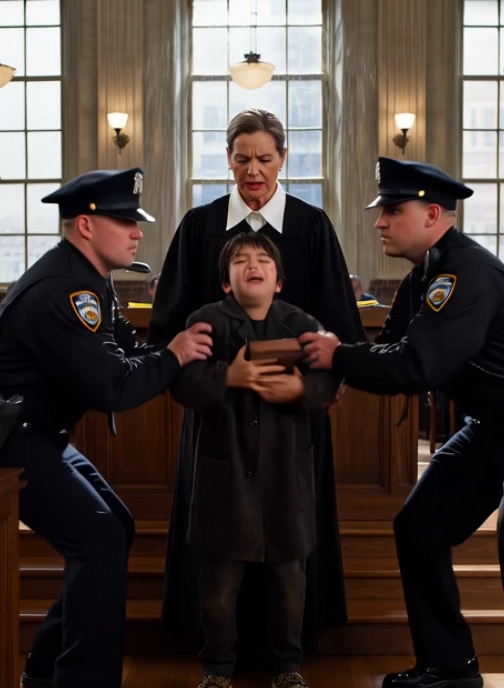
Rain hammered the courthouse windows while two police officers struggled with a filthy boy near the entrance.
He looked no older than ten.
His oversized coat was soaked through. Mud covered his shoes. One sleeve had been torn almost to the shoulder, and fresh scratches crossed his face.
Clutched against his chest was a small wooden box.
“I told you,” the boy cried. “I need to speak to the judge.”
“This is not a shelter,” one officer said. “You cannot wander into an active courtroom.”
“I didn’t wander in. She told me to come here.”
Eleanor struck her gavel.
“That is enough.”
The courtroom fell silent.
The boy looked toward the bench.
For one brief moment, Eleanor noticed how terrified he was.
Then she saw the wet footprints across the polished floor, the disrupted hearing, and the reporters watching her to see whether she could control her own courtroom.
“Remove him immediately.”
The boy’s face collapsed.
“No. Please.”
“You are interrupting an active proceeding.”
“I only need one minute.”
“You have already been asked to leave.”
“She said you would listen.”
Eleanor’s expression hardened.
“I do not know who ‘she’ is, but this is neither the time nor the place.”
One officer grabbed the boy’s arm.
He cried out and pulled away.
“Don’t touch the box!”
“Son, stop resisting.”
“You don’t understand!”
The second officer moved in.
The boy twisted between them, dropped to one knee, and forced open the wooden lid.
“Wait!” he screamed. “She said you would recognize this!”
Something golden caught the courtroom light.
Eleanor’s hand froze above her papers.
Inside the box rested a delicate gold necklace.
Its pendant had been shaped like a small flower, each petal engraved by hand. A blue stone sat at its center, surrounded by seven tiny diamonds.
The sight struck Eleanor with such force that she could not breathe.
The lawyers disappeared.
The officers disappeared.
The reporters disappeared.
She saw only her daughter, Claire, standing before a mirror on her sixteenth birthday.
Dark hair over her shoulders.
A white dress.
The golden flower resting above her heart.
Eleanor’s late husband, Thomas, had commissioned the necklace from a jeweler in Boston. There was only one like it.
Three words had been engraved on the back.
Bloom where planted.
It was the last gift Eleanor and Thomas had given Claire before their family began falling apart.
Eleanor slowly stood.
“Bring that to me.”
The officer looked confused.
“Your Honor?”
“The necklace.”
The boy immediately closed the box and pulled it against his chest.
“No.”
Gasps moved through the courtroom.
No one told Eleanor Whitmore no.
Her voice softened.
“Where did you get it?”
The boy stared at her.
His lips trembled.
“She gave it to me.”
“Who?”
He did not answer.
Eleanor stepped down from the bench.
As she approached, she saw bruising beneath the dirt on his face.
A cut near his eyebrow.
Red marks around his wrist.
He had not merely slept outside.
Someone had hurt him.
“What is your name?”
“Noah.”
“Noah what?”
“Just Noah.”
“Where are your parents?”
He looked at the box.
“Who gave you the necklace?” Eleanor asked.
Noah swallowed.
“Claire.”
The name moved through her like a blade.
“When did you see her?”
“Last week.”
“Where?”
“At our apartment.”
The word our did not escape her.
Eleanor’s voice became unsteady.
“Is Claire your mother?”
Noah looked at the reporters, the attorneys, and the strangers watching him as though he were evidence instead of a child.
“She told me not to answer questions unless I found you.”
Eleanor turned toward the bailiff.
“Clear the courtroom.”
The lead attorney rose.
“Your Honor, we are in the middle of—”
“Court is in recess. Everyone leaves.”
Within minutes, the courtroom had emptied except for Eleanor, Noah, two officers, her court clerk, and the bailiff, Samuel Grant.
Eleanor sat on one of the benches.
“Noah, sit down.”
He remained standing.
“Am I in trouble?”
“No.”
“You told them to throw me out.”
The truth landed without mercy.
“Yes,” Eleanor said. “I did.”
“Because I look bad?”
“No.”
“You didn’t let me talk.”
Eleanor had spent her career warning juries never to decide a case before hearing the evidence.
Yet she had looked at a dirty child and done exactly that.
“I was wrong.”
Noah studied her as though adults rarely admitted such things.
Then he sat at the opposite end of the bench.
Eleanor held out one hand.
“May I see the necklace?”
After a long pause, he opened the box.
Her hands shook as she lifted the flower and turned it over.
Bloom where planted.
A sob escaped her.
“Where is Claire?”
Noah’s eyes filled with tears.
“She’s gone.”
“What do you mean?”
“She got sick.”
“What hospital?”
“She wouldn’t go.”
“Why not?”
“She said people were looking for us.”
“What people?”
“The men from the black car.”
The bailiff glanced toward the officers.
“When did Claire die?” Eleanor asked.
“Last Tuesday.”
The answer emptied the room of air.
Claire had left home at twenty-three after an argument neither of them knew how to repair.
Claire accused Eleanor of controlling every decision she made.
Eleanor accused Claire of throwing away her education, her opportunities, and the family that loved her.
“If loving me means owning my life,” Claire had said, “then I would rather leave with nothing.”
She disappeared the next morning.
For eleven years, Eleanor hired private investigators, checked hospitals, followed rumors, and searched public records.
Every lead ended in silence.
Now a frightened boy sat before her carrying the necklace Claire had supposedly left on the kitchen counter.
“Why didn’t she contact me?” Eleanor asked.
“She wanted to.”
“Then why didn’t she?”
“She was scared.”
“Of me?”
“At first.”
The answer hurt.
“And later?”
“She said someone powerful would find us.”
Noah explained that Claire had been sick for months. She coughed blood but refused to see a doctor because identification records could be traced.
They moved between apartments, motels, shelters, and rooms rented under false names.
Claire worked nights cleaning offices.
Then the black car appeared outside their building.
“She packed a bag,” Noah said. “She gave me the box and told me to hide if anyone came inside.”
“Did they?”
He nodded.
“They broke the door. Mom pushed me into the laundry chute.”
“You stayed there?”
“All night.”
“What did you hear?”
Noah covered his ears.
“I don’t want to say.”
“All right.”
“They kept asking where the papers were.”
“What papers?”
“A red folder.”
“Did they find it?”
“I don’t know.”
“Did they hurt her?”
Noah began crying.
Eleanor waited.
Finally, he whispered, “She stopped making sounds.”
The judge turned away.
She had sentenced killers.
Reviewed autopsy photographs.
Listened to parents describe losing their children.
None of it prepared her for learning about Claire from a ten-year-old in a torn coat.
“How did you escape?”
“The next morning. They were gone.”
“And Claire?”
“She was on the floor.”
Noah reached inside his coat.
The officers tensed.
“It’s only a letter.”
He removed a folded envelope stained by rain.
Eleanor’s name was written across the front.
Not Judge Whitmore.
Not Your Honor.
Just:
Mom.
Eleanor recognized Claire’s handwriting.
The first sentence read:
Mom, if Noah reached you, then I ran out of time.
Claire wrote that Noah was Eleanor’s grandson.
His father was a man Eleanor had once sent to prison.
His name was Vincent Rourke.
Twelve years earlier, Eleanor had sentenced Rourke for extortion, witness intimidation, and falsifying court documents.
The prosecution believed he controlled a larger criminal organization, but witnesses vanished and financial records disappeared.
Rourke received only three years.
He served eighteen months.
After his release, he found Claire.
At first, Claire believed he wanted revenge against Eleanor.
Instead, he became charming, attentive, and patient.
By the time she understood what he truly wanted, she was pregnant.
Claire escaped with Noah and took evidence Rourke had stored in a private office.
For ten years, he searched for them.
The final paragraph read:
Do not send Noah into foster care. That is where Vincent’s people will look first. He owns judges, clerks, officers, doctors, and child-welfare contractors. I took a ledger that proves it. I hid the original where the children were kept. Noah has the key.
Eleanor looked up.
“What key?”
Noah removed a flash drive attached to a small brass key.
“She told me this could put bad people in prison.”
“Do you know what is on it?”
“Names. Money. Judges.”
The word made Eleanor’s heart stop.
“Did she mention me?”
“No.”
He hesitated.
“But before she died, she told me something else.”
“What?”
Noah looked toward Eleanor’s private chambers.
His face went pale.
“She said I had to give you the letter before the man in your office found out I was here.”
Eleanor slowly turned.
The door to her chambers stood open.
She had closed it before stepping down from the bench.
A shadow moved behind the frosted glass.
Noah grabbed her hand.
“That’s him,” he whispered.
“The man from the black car.”
The door opened.
Martin Hale stepped into the courtroom.
For fourteen years, Martin had served as Eleanor’s court administrator.
He managed her schedule.
Handled sealed files.
Coordinated security.
He had attended Thomas’s funeral.
He had brought flowers every year on Claire’s birthday.
Now he stood inside Eleanor’s chambers holding a leather briefcase.
“Your Honor,” he said calmly, “step away from the boy.”
Bailiff Grant reached for his radio.
Martin drew a handgun.
The first shot shattered the radio.
The second struck Grant beneath the shoulder.
He fell against the bench.
The officers moved toward their weapons.
“Do it,” Martin warned, “and the boy dies.”
He aimed at Noah.
Eleanor moved in front of him.
“You worked for Vincent.”
Martin smiled faintly.
“Vincent is my brother.”
The courthouse alarm began screaming.
Metal security doors descended over the public entrances.
The lights went out.
Martin had activated the emergency lockdown from Eleanor’s chambers.
In the red glow of the backup lights, he extended one hand.
“Give me the drive and the key.”
“No.”
“You already lost your daughter.”
His voice became colder.
“Do not make the same mistake with her son.”
Eleanor looked at Grant bleeding on the floor.
At the officers trapped behind benches.
At Noah holding her hand so tightly his fingers had turned white.
Then she remembered a passage behind the jury box.
An old service corridor installed when the courthouse was built.
Only judges and maintenance personnel knew it existed.
She leaned toward Noah.
“When I tell you to run, go behind the jury box.”
Martin’s eyes narrowed.
“What did you say?”
Eleanor picked up the wooden box.
“I said Claire trusted the wrong person.”
She threw it toward him.
Martin instinctively reached for it.
The box struck the floor.
The necklace slid beneath a bench.
“Run!”
Eleanor pulled Noah toward the jury box.
A gunshot struck the wall beside them.
They reached the service door as one of the officers tackled Martin.
Another shot exploded.
Eleanor pushed Noah into the dark corridor and followed.
Behind them, Martin shouted:
“You cannot hide him forever!”
The service passage descended beneath the courthouse.
Eleanor locked the steel door behind them.
Noah was shaking so violently he could barely stand.
“Is the officer dead?” he asked.
“I don’t know.”
“Is he going to find us?”
“Not if I can help it.”
They moved through the narrow tunnel until Eleanor saw daylight beneath an exterior maintenance door.
She called emergency services from her personal phone.
Within minutes, state police surrounded the courthouse.
Bailiff Grant was taken to surgery.
Martin Hale was gone.
He had escaped through Eleanor’s chambers using an underground parking entrance that only courthouse administrators could access.
The wooden box remained in the courtroom.
The necklace was recovered.
But Martin had taken something else from Eleanor’s office.
Every sealed case file connected to Vincent Rourke.
And the confidential list of addresses used by the city’s child-protection program.